


Why frequent, focused practice can make the difference between a child who understands something today and a child who can use it confidently tomorrow.
Imagine a child having an excellent English lesson. The tutor explains how to build a compelling story, the child understands the technique, and together they write a much-improved paragraph. Everyone finishes feeling positive. Job done?
Not quite.
Ask the child to write another story a week later, without the tutor’s help, and something interesting may happen. The brilliant opening has disappeared. The description is back to “It was a dark night.” The story has a character, a setting and absolutely no idea where it is going.
What happened to all that learning?
Nothing unusual. Understanding something when it is explained is not quite the same as being able to do it independently. Learning requires not just good teaching, but opportunities to practise, remember, apply and improve.
The student who does that most effectively, wins.
1. One lesson is a beginning, not a magic wand
A good tutor can make a tremendous difference. They can identify a weakness, explain a difficult concept, demonstrate a technique and help a child overcome a problem.
But a lesson is a relatively short window of learning. If a child only practises a skill during that window, they have limited opportunities to turn the tutor’s explanation into their own ability.
Think about learning to play the piano, ride a bicycle or play football. You would not expect a child to master these skills after one weekly demonstration. They need repeated opportunities to try, make mistakes, adjust and try again.
English is no different. Children need to write regularly, experiment with vocabulary, practise sentence construction, organise ideas and learn to recognise what makes a piece of writing effective.
The tutor provides the instruction. Practice gives the child the opportunity to make that instruction their own.
2. What does the research say?
This is not simply an educational hunch. It is supported by decades of research into how people learn.
In a major review published in “Psychological Science in the Public Interest”, researchers John Dunlosky and colleagues examined ten common learning techniques. Two received particularly strong ratings: distributed practice and practice testing.[1]
Distributed practice means spreading learning opportunities over time instead of concentrating everything into one long session. Practice testing means actively trying to retrieve or use what has been learned, rather than simply looking at the information again.
A later systematic review examined retrieval practice in real classrooms and schools. Across 50 experiments involving 5,374 participants, the majority of reported effects showed medium or large benefits for learning.[2]
In plain English, children benefit from returning to material and actively using what they have learned. They should not merely hear an explanation and hope it sticks.
This does not mean that every child must practise every subject every day. Nor does it establish one perfect schedule for every skill. It means that “regular opportunities to retrieve and apply learning deserve a central place in education”.
3. Why frequent practice matters in English
Some people imagine that writing is a mysterious talent: a child either has a gift for words or does not.
In reality, good writing draws on many skills that can be developed. A child must generate ideas, select vocabulary, construct sentences, organise paragraphs, use punctuation and maintain a coherent story or argument.
These demands compete for the child’s attention. When basic skills become more familiar, the child has more capacity to concentrate on meaning, creativity and structure.
Consider a child learning to use varied sentence openings. One explanation may help them understand the technique. A short exercise the next day gives them another opportunity to use it. A story later in the week challenges them to apply it in context. Feedback helps them see what worked and what still needs attention.
That is a much richer learning process than completing one exercise and moving on forever.
The same principle applies to comprehension. Children need repeated opportunities to identify evidence, infer meaning, explain a writer’s choices and justify their answers. Reading a model answer can be useful, but attempting the question themselves reveals what they can actually do.
4. But surely more practice means more homework?
Not necessarily. Effective practice is not about filling every spare minute with worksheets.
It is about making learning regular, focused and manageable. A short task with a clear purpose can be more useful than a long session in which a tired child rushes to finish.
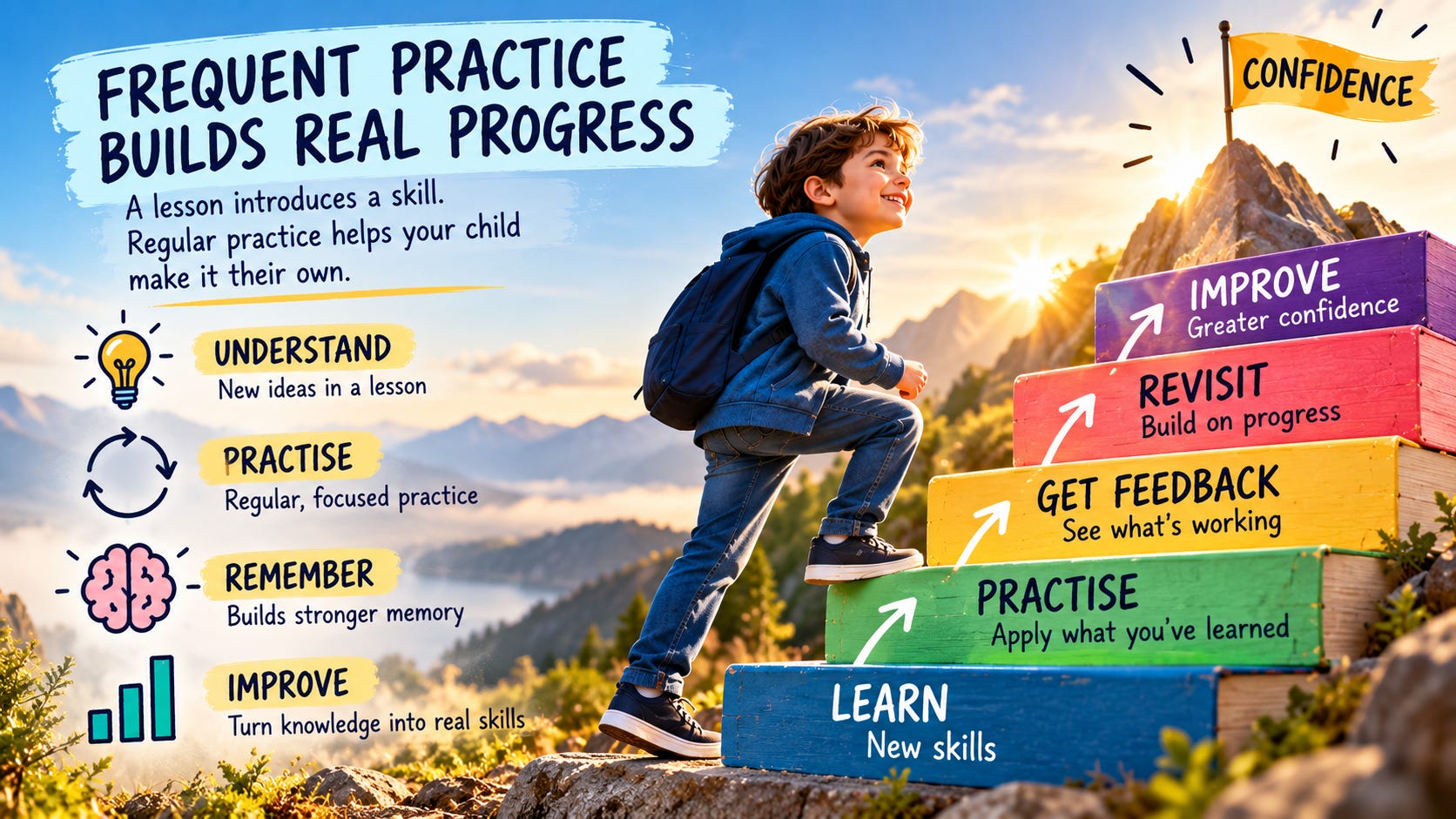
A sensible practice routine might include:
Recall: Ask the child to explain a technique learned previously, without looking at the notes.
Focused practice: Give them a short task targeting one specific skill.
Application: Ask them to use that skill in a larger piece of writing or a comprehension answer.
Feedback: Identify what they did well and one improvement to make next time.
Revisit: Return to the skill after an interval and see whether they can still use it.
The aim is not repetition for its own sake. It is gradual movement from supported performance towards independent ability.
And practice should not become a daily battle. Tasks need to be age-appropriate, achievable and varied enough to sustain interest. Children also need time to rest, play and pursue other interests.
5. The tutor’s job is to make practice work
There is an important distinction between simply assigning practice and designing it well.
A child who repeatedly makes the same mistake without feedback may simply reinforce an unhelpful habit. Equally, a child who only completes tasks they already find easy may make little progress.
The tutor’s role is to choose the right next challenge, explain unfamiliar techniques, provide useful feedback and revisit skills at appropriate intervals.
Research also supports the value of tutoring itself. A 2024 systematic review and meta-analysis by Andre Nickow, Philip Oreopoulos and Vincent Quan examined 89 randomised controlled trials of tutoring programmes. It found positive average effects on learning, with larger effects associated with programmes that met more frequently, among other factors.[3] This is evidence about tutoring programmes overall, not a guarantee that more sessions will always produce better results for every child.
The practical lesson is that teaching and practice should work together. Children need expert guidance, but they also need opportunities to use that guidance beyond the lesson.
6. Small steps, repeated, can build lasting skills
Parents naturally want to know whether their child is improving. One impressive piece of writing can be encouraging, but it does not necessarily show whether the child can reproduce that standard independently.
Look instead for progress over time: clearer sentences, more deliberate vocabulary choices, better-organised stories, stronger explanations and fewer repeated errors.
These changes may arrive unevenly. Some skills improve quickly; others need sustained attention. Regular practice makes it easier to identify what is improving and what needs further teaching.
So, the next time your child finishes a brilliant lesson, celebrate it. Then ask the more important question:
What will they practise next—and when will they get the chance to use what they have learned?
Because good teaching opens the door. Frequent, purposeful practice helps children learn to walk through it themselves.
--————————————————————————————————-
Sources and further reading
**[1] Dunlosky, J. et al. (2013).** *Improving Students’ Learning With Effective Learning Techniques: Promising Directions From Cognitive and Educational Psychology.*
https://doi.org/10.1177/1529100612453266
**[2] Agarwal, P. K., Nunes, L. D. & Blunt, J. R. (2021).** *Retrieval Practice Consistently Benefits Student Learning: A Systematic Review of Applied Research in Schools and Classrooms.*
https://doi.org/10.1007/s10648-021-09595-9
**[3] Nickow, A., Oreopoulos, P. & Quan, V. (2024).** *The Promise of Tutoring for PreK–12 Learning: A Systematic Review and Meta-Analysis of the Experimental Evidence.*
https://doi.org/10.3102/00028312231208687