


Children need to study smarter, not study harder
Why highlighting, rereading and hours of revision might be wasting your child’s time – and what educational psychologists say works better.
Visualize two children preparing for an English examination.
Child A spends an hour reading a textbook, highlighting important sentences in yellow, then reading the same pages again. The textbook is now a beautiful patchwork of fluorescent colours. The child feels productive. The parent feels reassured.
Child B spends 20 minutes learning the material, puts the textbook away, and tries to remember what they have learned. They answer questions, explain ideas in their own words and practise applying their knowledge. A few days later, they repeat the exercise.
Which child most likely learned more? You might be surprised by the answer.
Educational psychologists have spent decades investigating precisely this question. One particularly important study, published in 2013, offers some fascinating insights into how children learn – and why some conventional study habits are considerably less effective than we might think.
The research: What actually makes learning effective?
In 2013, five prominent researchers – John Dunlosky, Katherine Rawson, Elizabeth Marsh, Mitchell Nathan and Daniel Willingham – published a major review entitled:
*Improving Students’ Learning With Effective Learning Techniques: Promising Directions From Cognitive and Educational Psychology.*
Published in *Psychological Science in the Public Interest*, the paper examined ten commonly used learning techniques.
Rather than simply asking whether a technique could help someone learn something, the researchers considered how reliably it worked across different ages, abilities, learning materials and assessment tasks: the conclusions were surprisng.
Some techniques that students use regularly received surprisingly poor ratings. Others, which are relatively simple to implement, received the highest ratings.
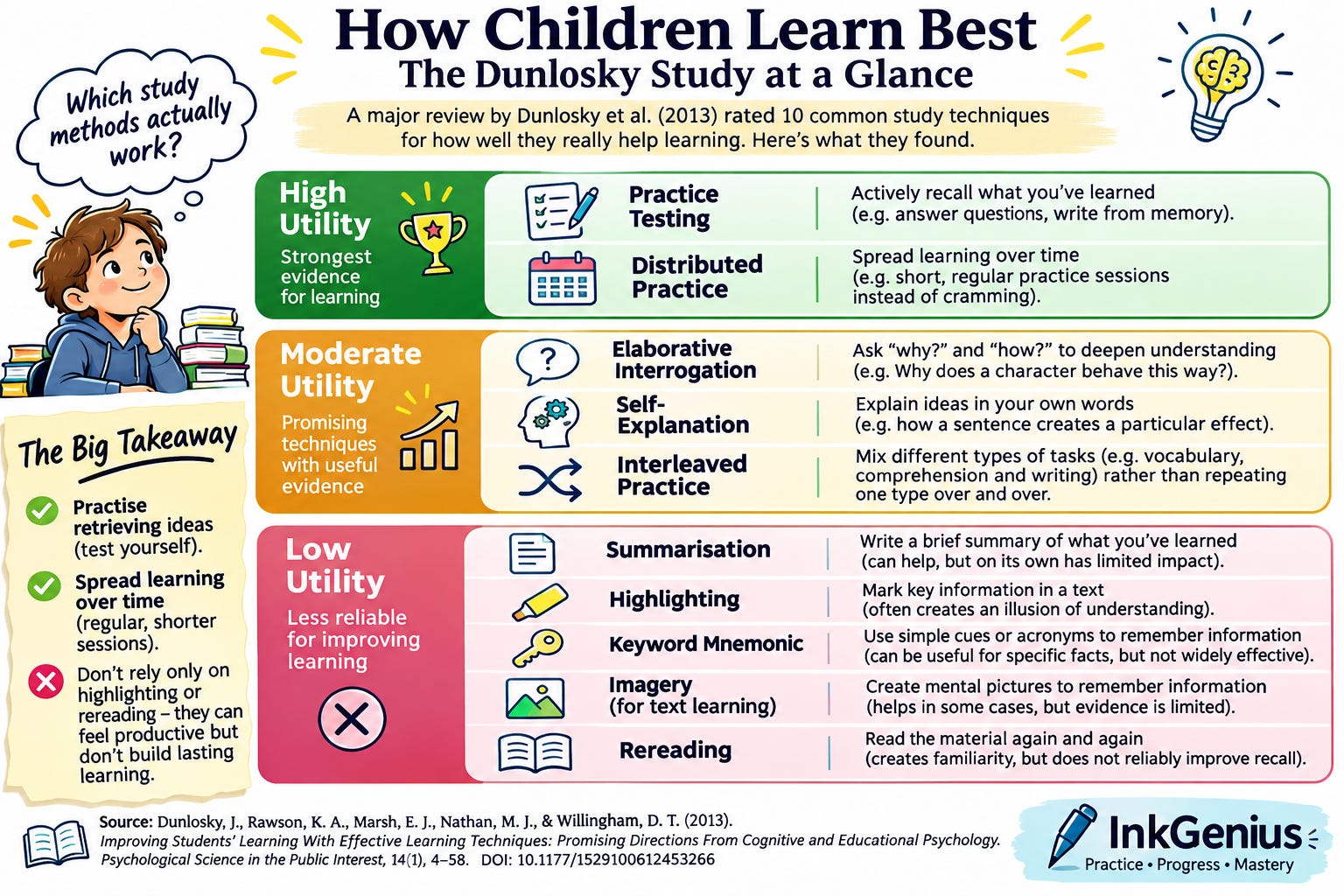
The researchers identified two particularly effective techniques:
1. Practice testing.
2. Distributed practice.
Let’s dive in to understand why.
1. Practice testing: Stop reading. Start remembering.
Most children are familiar with revision. They read their notes, look through textbooks and perhaps highlight important information.
But there is a fundamental difference between recognising information and remembering it.
When a child reads a page for the third time, the information looks familiar. This can create the impression that they know it.
The key question in an exam or other test of retained knowledge is can they explain it without looking?
That is a different question.
Practice testing involves actively retrieving information from memory rather than simply looking at it again.
For example, instead of asking a child to reread a passage about the Romans, ask them:
- What were the three main reasons the Romans invaded Britain?
- Can you explain what happened in your own words?
- What evidence supports your answer?
- Can you remember the important vocabulary?
The child has to retrieve information, organise it and reconstruct an answer.
This is much more demanding than simply recognising something on a page.
Dunlosky and his colleagues gave practice testing a “high utility rating”, finding that it benefited learners across a wide range of circumstances.
The paper explains that practice testing can improve learning beyond the immediate testing situation, helping students retain information over time.
In other words, answering questions isn’t just a way of finding out what a child knows. It can actually help them learn.
And this has important implications for mastering English, particularly for the purposes of acing exams.
The goals within the UK syllabus are not complicated, but they are broad.
A child learning comprehension should regularly practise answering questions without simply copying sentences from the passage.
A child learning composition should regularly practise applying vocabulary, sentence structures, punctuation and writing techniques in original work.
Learning becomes active rather than passive.
2. Distributed practice: Why cramming is a poor substitute for consistency
Consider a different exemplar: two approaches to learning ten new vocabulary words.
The first child spends two hours learning all ten words on Sunday evening.
The second child spends 15 minutes practising them each day over several days.
Both children have spent considerable time studying. But their learning schedules are very different.
The second approach is known as distributed practice, sometimes called spaced practice.
Instead of concentrating learning into one long session, practice is spread across multiple sessions over time.
Why does this matter?
Because learning something once does not necessarily mean you will remember it tomorrow, next week or next month.
Returning to material after an interval requires the learner to retrieve and reconstruct what they previously learned.
It also creates opportunities to identify gaps and strengthen understanding.
Dunlosky and his colleagues rated distributed practice as another “high utility technique”.
The important lesson is that learning should not be treated as a single event.
It should be a process.
For parents, this has a practical implication: a child who practises regularly for relatively short periods may benefit more than one who relies on occasional marathon tutoring sessions.
Consistency matters.
3. The surprising truth about highlighting and rereading
This may come as a total shock to most. Highlighting and rereading are two of the most popular revision techniques utilised for generations. ‘That’s how we studied’ may be a common retort to kids, but in this case the adult in question would be wrong.
Highlighting and rereading received low utility ratings in the Dunlosky review.
That doesn’t mean they are completely useless. Highlighting can help identify important information, and rereading can sometimes improve familiarity with material.
But neither technique reliably produces the learning improvements that many students assume.
The problem is that they can create an illusion of understanding.
When you read something repeatedly, it becomes easier to recognise. Unfortunately, recognising information is not the same as being able to recall it, explain it or apply it.
Think of it this way.
Watching someone play the piano repeatedly doesn’t mean you can play the piano. Reading a brilliant piece of writing doesn’t mean you can reproduce its techniques in your own work. And watching a maths teacher solve a problem doesn’t mean you can solve it yourself.
At some point, you have to do the work and it is the act of ‘doing’ that leads to learning and eventually to mastery.
This is why active practice matters.
4. Three other techniques worth understanding
The researchers also examined several other learning techniques.
Three received moderate utility ratings:
Elaborative interrogation
This involves asking why something is true and developing explanations.
Rather than memorising that a particular character behaves selfishly, a child might ask: Why does the character behave this way? What evidence supports this interpretation?
Self-explanation
This involves explaining how something works or why an answer is correct.
A child might explain why they chose a particular word, how a sentence creates an effect or why a particular interpretation of a passage makes sense.
Interleaved practice
Rather than practising one type of problem repeatedly, learners alternate between different types of tasks.
For example, a child might practise vocabulary, sentence construction and comprehension questions in the same learning programme.
These techniques are promising, although the authors emphasise that the evidence supporting them was less comprehensive than for practice testing and distributed practice.
5. What does this mean for learning English?
The research has particularly interesting implications for teaching children English.
The traditional advice for children is ‘read, read and read’. That is good advice however, there may be more effective tools too.
English is not simply a subject that children can learn by reading a textbook or memorising a list of rules.
It involves a collection of interconnected skills:
- Understanding vocabulary and language.
- Interpreting meaning and identifying evidence.
- Constructing sentences accurately.
- Organising ideas into paragraphs.
- Developing arguments and explanations.
- Writing creatively and communicating effectively.
These skills require repeated application.
Consider creative writing.
A child might read an excellent descriptive passage and understand that the author uses interesting vocabulary, varied sentence structures and figurative language.
But understanding these techniques is not the same as being able to use them.
The child needs to practise.
They need to attempt their own descriptions, experiment with vocabulary, construct sentences, receive feedback and try again.
The same applies to comprehension.
Reading a passage and looking at the answers is not enough. Children need to interpret, retrieve, explain and justify their answers independently.
This is where the principles of practice testing and distributed practice become particularly useful.
Conclusion
The science of learning has come a long way in the past two decades. We understand more about how the brain works, the development of neural pathways and how people gain and retain knowledge.
In this era of extraordinary change, learning to learn better could be the most useful superpower.
We hope you enjoyed these insights into learning. If putting them into practice seems a daunting task, don’t worry: at InkGenius.Tech we have done that for you. Check out our English teaching system that incorporates modern learning science below.
___
Explore InkGenius.Tech: Learn, Practise, Master
Give your child the edge in English. InkGenius combines expert live teaching with personalised daily practice to build mastery in Comprehension and Composition.
Designed for ages 6–11, including 7+, 8+ and 11+ preparation.
Don’t just prepare. When every mark counts, Master English.
Start your FREE trial here.
Watch a video about InkGenius.Tech here.
---
Read the research for yourself
Dunlosky, J., Rawson, K. A., Marsh, E. J., Nathan, M. J. and Willingham, D. T. (2013).
*Improving Students’ Learning With Effective Learning Techniques: Promising Directions From Cognitive and Educational Psychology.*
Psychological Science in the Public Interest, 14(1), 4–58.
**DOI:** https://doi.org/10.1177/1529100612453266
[Read the full research paper via SAGE](https://journals.sagepub.com/doi/pdf/10.1177/1529100612453266)
[Read the abstract via the Association for Psychological Science](https://www.psychologicalscience.org/journals/pspi/1529100612453266)
**Discover InkGenius:** https://www.inkgenius.tech/
A structured approach to developing your child’s English comprehension and composition through regular practice, feedback and progressive learning.