

Seven percent of children in the UK attend private schools. That is over a half a million children. With a rising cost of living and the implementation of VAT (sales) taxes on these schools, many parents are asking themselves is this worth it? It is a complicated question.
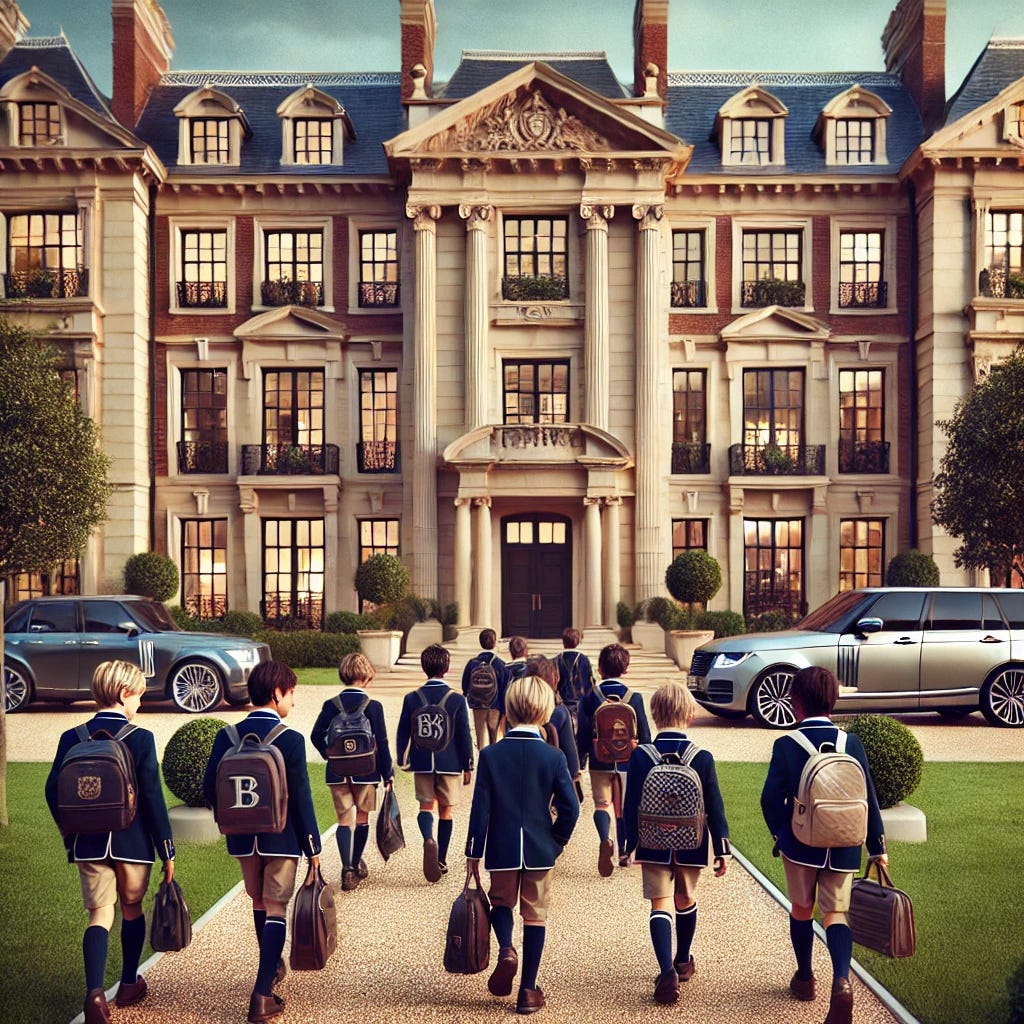
The question becomes even more relevant when considering the goal. For many it is about a path to a reputable university, and thereafter suitable employment. In an effort to support less privileged students, universities have announced efforts to take in more children from non-fee paying schools.
The open letters from heads of prestigious fee paying schools decrying the quota systems applied to students from elite schools reflects concern in the private school parental community.
And when you look at the AI generated image above, you would think why not tax these schools more? However, more often than not, AI is representative of the cliche view on an issue - that algorithm sifts through available material to compose it’s representation. Doubtless, that image above, created by ChatGPT, is similar to that conjured up in the minds of millions of voters, when they think of a private school.
For most middle class parents though, fee-paying schools are far less glamorous. They are a sacrifice made to give their children a better start. And so in these challenging economic times, we thought a comprehensive piece on the subject would be useful.
We grapple with some thought provoking questions in this piece. First, we provide a basic categorisation of private schools. We then consider what private schools are really looking for in kids, and yes, parents. Private schools have many advantages, beyond those listed in glossy brochures, and we grapple with the most important benefits that no one talks about. Finally, we get to the critical question - the skills of the future, in an uncertain age of automation (AI, robotics, etc), and consider what how privates schools contribute, and if you are not at a private school, how you can ensure it isn’t a disadvantage to your child.
So let’s dive in.
First let’s set out a crude topography of the world of private schools.
Not all private schools are the same
One important caveat is that not all private schools are the same. There are rankings that list schools by their academic performance, and those in the top set (top 20) likely prize academic achievement more than the rest.
This crude chart below is a useful taxonomy of schools and their cultures, that permits us to dive into the costs and benefits of the various types of schools.

So we have created a chart above for you to think about the type of school that exists, in the private space, but also more generally.
Type A above are the elite schools. Top of the academic tables, often with the most students going to the next preferred destination (elite university, etc), and very challenging to gain entry to. They have a competitive culture, attract the right type of students (and associated competitive parents - see an article about those highly driven stereotypes here) and produce great results.
Type B is a unicorn - we don’t know any that exist. They produce great results, with a relaxed culture. Perhaps that is where technology comes in. That said with technology, individuals like Elon Musk want to set up schools that have a material improvement on the current system - may be they will get us to that utopia. The Creative Writing platform InkGenius.Tech (link here) is one example of how technology can make learning both easier and more effective.